Abdul El-Sayed Won: Revisiting the Democratic Establishment’s Medicare for All Problem
Abdul El-Sayed Won: Revisiting the Democratic Establishment’s Medicare for All Problem
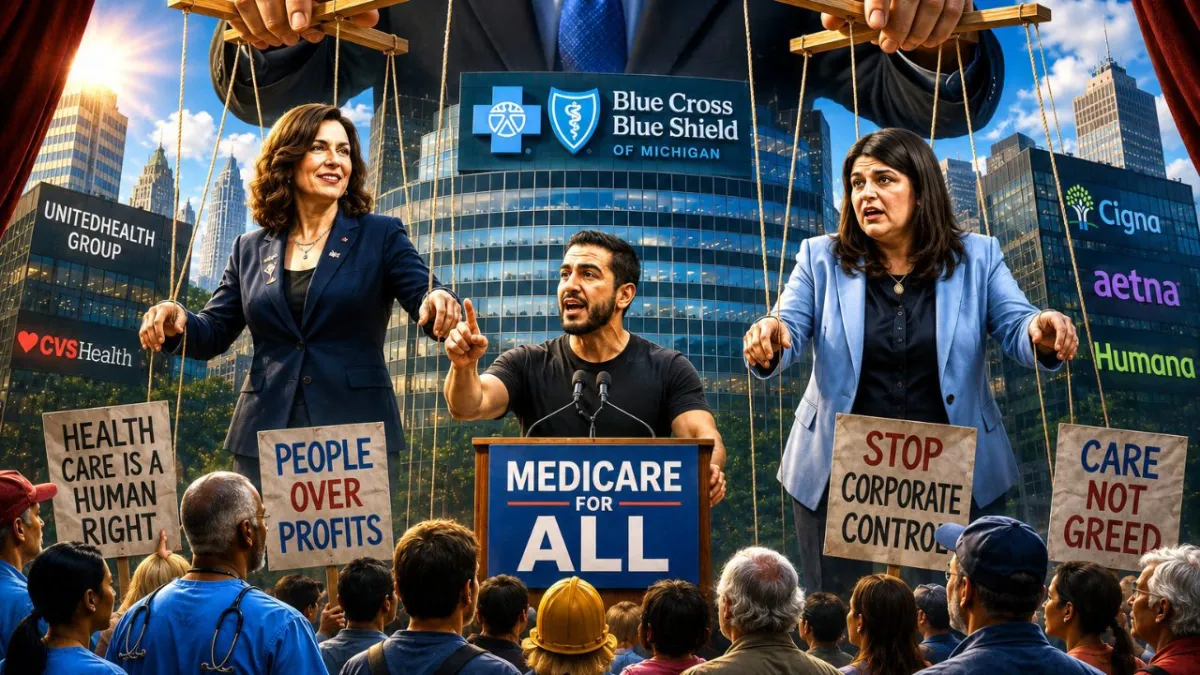
From Gavin Newsom in California to Gretchen Whitmer in Michigan, the debate over Medicare for All continues to expose the tension between campaign promises, corporate influence, and the political power of the health insurance industry.
Editor’s note: We are republishing this article following Abdul El-Sayed’s victory over establishment-backed Rep. Haley Stevens in Michigan’s Democratic Senate primary. Despite being dramatically outspent and opposed by powerful party leaders and corporate interests, El-Sayed prevailed on a platform centered on Medicare for All, economic justice and an end to unconditional U.S. military aid to Israel. His victory reinforces the argument made below: Democratic voters are not rejecting bold progressive policies—they are rejecting a party establishment determined to contain them.
Joshua Scheer
Michigan’s Democratic Senate primary is increasingly becoming a referendum on who really shapes the party’s agenda: voters or the powerful corporate interests that finance modern campaigns. With David Sirota reporting examines why Whitmer’s endorsement cannot be viewed as just another political calculation. Instead, he places it within the broader struggle over Medicare for All and the political influence of the health insurance industry in Michigan.
As Sirota argues, Abdul El-Sayed’s campaign represents something far more consequential than another Democratic primary challenge. His candidacy is built around Medicare for All—a proposal that would fundamentally reshape the private insurance industry. That reality, Sirota contends, helps explain why so much of the Democratic establishment has rallied behind Haley Stevens, whose positions pose no comparable threat to the existing health care system.
For years, Abdul El-Sayed has made Medicare for All the centerpiece of his public life and political career. He has written extensively on the subject and is now campaigning for the U.S. Senate on a promise to replace the private insurance system with universal coverage. That makes him a direct political challenge to an industry that has spent decades protecting its place at the center of American health care. His opponent, Rep. Haley Stevens, does not support Medicare for All, making her a far less disruptive prospect for the insurance industry.
Against that backdrop, Gov. Gretchen Whitmer’s endorsement of Stevens carries significance beyond a routine political endorsement. Critics argue it reflects the interests of an established Democratic network with longstanding ties to Michigan’s health insurance industry.
Whitmer’s connections to Blue Cross Blue Shield of Michigan have long drawn scrutiny. Her father served as the company’s chief executive for many years, and Blue Cross donors were among the largest financial supporters of her gubernatorial campaign. Reporting at the time also highlighted the company’s close relationship with her campaign, and after taking office Whitmer selected Blue Cross’s CEO to serve as an honorary co-chair of her transition team. Those relationships have fueled renewed questions about whether Michigan’s political establishment is closing ranks against a candidate whose signature proposal would fundamentally reshape—or potentially eliminate—the private insurance model on which companies like Blue Cross depend.
Once again, I find myself writing about Gavin Newsom—his ties to the billionaire class, his failure to deliver Medicare for All in California, and his recent claim that such reform can only happen at the national level. It is an argument that conveniently ignores the opportunities he had to lead when he had the chance.
Now, Michigan offers a strikingly similar example. As David Sirota’s reporting makes clear, Gov. Gretchen Whitmer’s endorsement in the Senate primary raises broader questions about the Democratic Party’s
Part of an ongoing event
Israel-Hamas Conflict