Gaza families bury 112 people recovered nearly three years after Israeli strikes
Gaza families bury 112 people recovered nearly three years after Israeli strikes
Mohammed al-Hajjar
Remains recovered from beneath the rubble renew grief for families still searching for thousands missing in Gaza
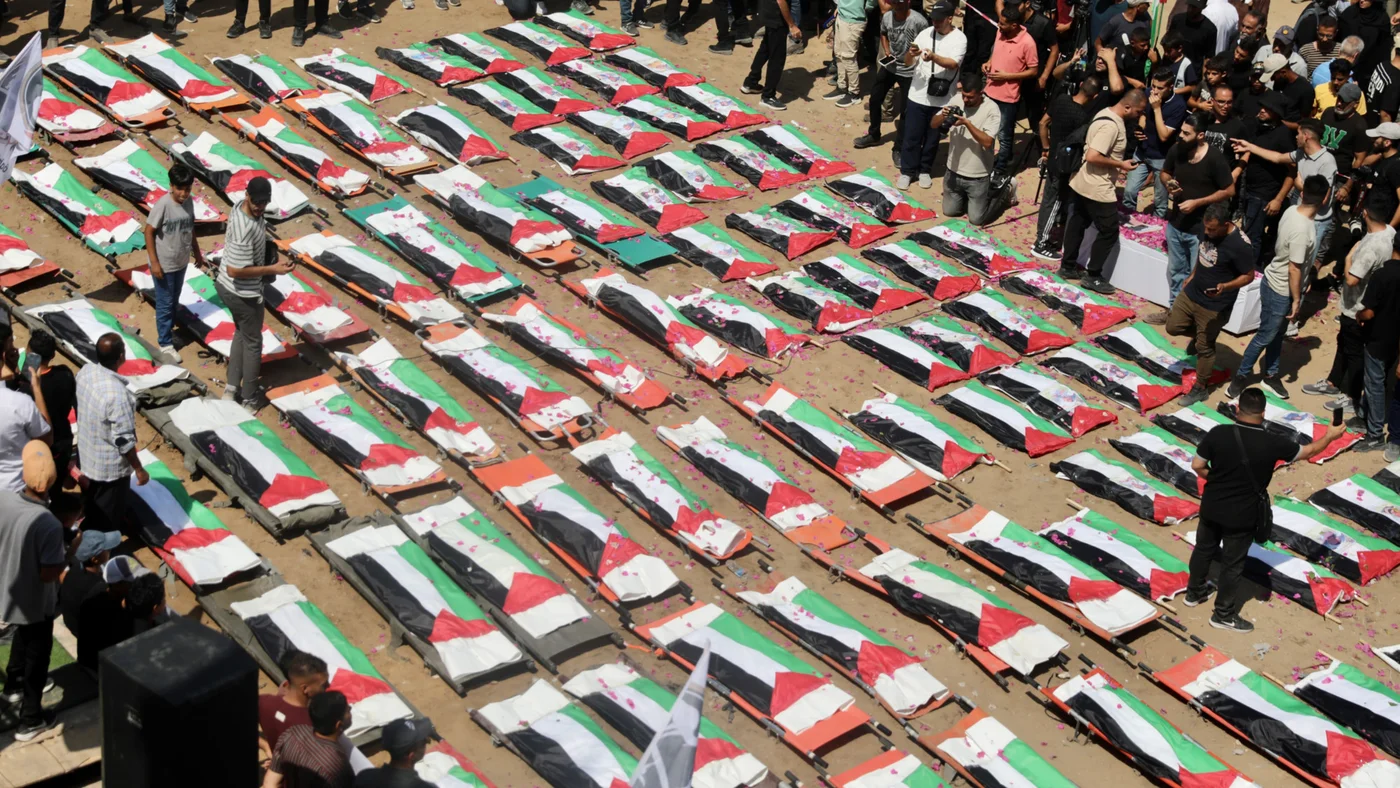
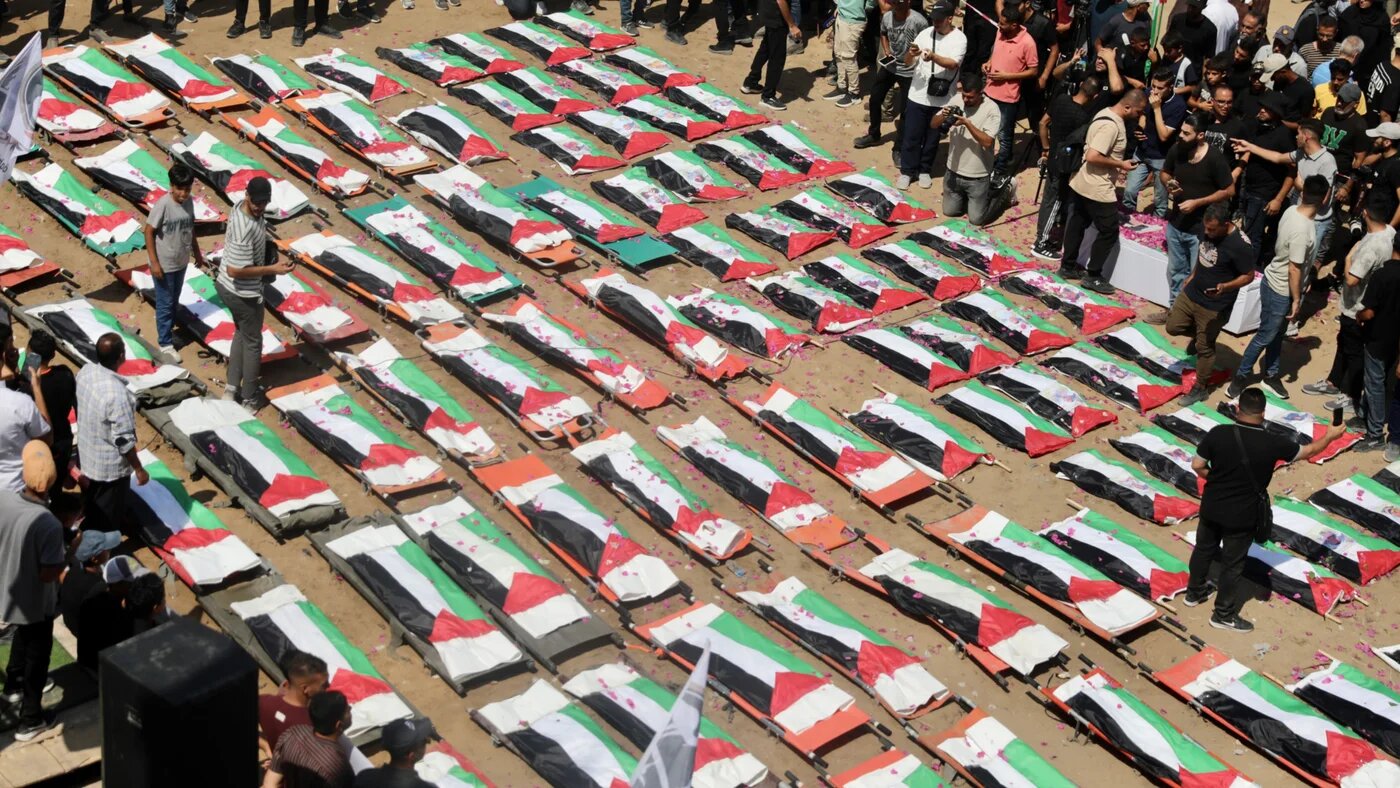
The bodies of 112 Palestinians killed in an Israeli air strike in 2023 were laid to rest in Gaza City on 4 August 2026 (Mohammed al-Hajjar/MEE)
Palestinians on Tuesday buried 112 members of a single clan killed in Israeli air strikes in November 2023, after their remains were recovered from beneath the rubble last month.
Relatives of the Abu Shari'a and al-Hasayna family gathered in Gaza City to bid a final farewell to their loved ones, whose bodies lay in rows draped in Palestinian flags.
For many, it was a moment of both relief and renewed grief after nearly 1,000 days of waiting to recover the bodies of their relatives.
"There is a feeling of both pain and joy," Amer Abu Shari'a, who lost relatives in the attack, told Middle East Eye.
"Joy because we will bury and honour these martyrs after three years. But the sorrow has returned, as if the massacre happened today."
The strike on the Sabra neighbourhood was one of the deadliest single-strike casualty events of the two-year genocide.
Israeli warplanes flattened an entire residential block where hundreds of members of the Abu Shari'a and al-Hasayna clan had been living and sheltering.
'We worked for 17 days to recover the bodies in extremely difficult conditions'
- Mahmoud Basal, Civil Defence spokesperson
More than 300 people were killed, including 44 children, 37 women and more than 10 people with disabilities.
Most remained buried beneath the collapsed buildings.
Efforts to recover bodies from the rubble were halted in the early months of the war because search-and-rescue teams lacked the heavy equipment needed for the operation, which had been destroyed or blocked from entering Gaza by Israel.
Civil Defence crews resumed searching the site on 14 July using limited and inadequate equipment.
Officials said the force of the explosions had scattered human remains, making the recovery operation even more difficult.
Scores of people attended the mass burial to pay their respects to the victims and their families (Mohammed al-Hajjar/MEE)
By 1 August, crews had recovered the remains of 112 people, with more victims still believed to be buried beneath the debris.
"We worked for 17 days to recover the bodies in extremely difficult conditions. In the end, we managed to recover the remains of 112 people," Mahmoud Basal, spokesperson for the Palestinian Civil Defence in the Gaza Strip, told MEE.
"Thousands of people are still buried beneath the rubble, while their families continue to grieve and plead for the means to recover them."
Reopened wounds
Among those killed were prominent members of the family, including Fathi Abu Shari'a, the clan's mukhtar, or elder representative.
After his home was struck, scores of people sought refuge in the house of Mofeed al-Hasayneh, who served as the Palestinian Authority's minister of public works and housing between 2014 and 2019 and held American citizenship.
According to Mahmoud al-Hasayneh, who survived the attack, around 200 members of the Hasayneh family had taken shelter there, believing the house would be spared.
'Every time a body was recovered, relatives abroad would call and cry'
- Mahmoud al-Hasayneh, survivor
It too was bombed, killing the former minister and those sheltering with him.
"Unfortunately, the Israelis respected neither children nor women, nor immunity, nor any house, nor any sanctity," al-Hasayneh said.
"They struck everyone here," he added, noting that many of those killed held Romanian, British and American citizenship.
Al-Hasayneh was not at the house when it was hit. His son, brother and their families were among those
Part of an ongoing event
Israel-Hamas Conflict