When ICE Detained Two Iranian Sisters, An L.A. Pastor Answered the Call
When ICE Detained Two Iranian Sisters, An L.A. Pastor Answered the Call
By Jeremy Lindenfeld Capital and Main
Pastor Kevin Kang had only been at Tujunga United Methodist Church for a couple of years when, in December of last year, he was asked if he could house formerly detained refugees on church grounds. Without telling his congregation, Kang called up some friends to help him clear out furniture from his office and set up some beds. Over the next few days, Kang said rumors began to circulate among church members about the supposed “criminals” he was harboring, so he figured he should set the record straight.
Without warning, Kang arrived at the next trustees meeting with his new guests: two Iranian sisters in their 20s fleeing religious persecution in their home country. Data analyzed by Capital & Main sheds light on why they found themselves needing help. In 2024, only three Iranians were arrested by Immigration and Customs Enforcement in the seven counties policed by ICE’s Los Angeles field office. In 2025, that number jumped to 154. That 51-fold increase in arrests was proportionally the largest for any nationality in the region.
Most of the half-dozen people in attendance at the trustees meeting in early January were skeptical when Kang introduced the recently released young women, who he had met through Clergy and Laity United for Economic Justice (CLUE), an interfaith organization that has been coordinating a welcome network for asylum seekers and refugees since 2023.
“At first we didn’t really understand,” said 94-year-old Jean Van Vlear, who was at that meeting and has been attending Tujunga United Methodist for over 60 years. “We were still trying to get used to a new pastor and his ways.”
Some trustees, like 81-year-old George Beach, already had political disagreements with Kang, who is an unapologetic progressive. Beach voted for Trump three times and wishes he could run for another term.
“On church things, we’re 100% [in agreement],” Beach said. “The biggest disagreement is the illegals. I’m with ICE, he’s against it.”
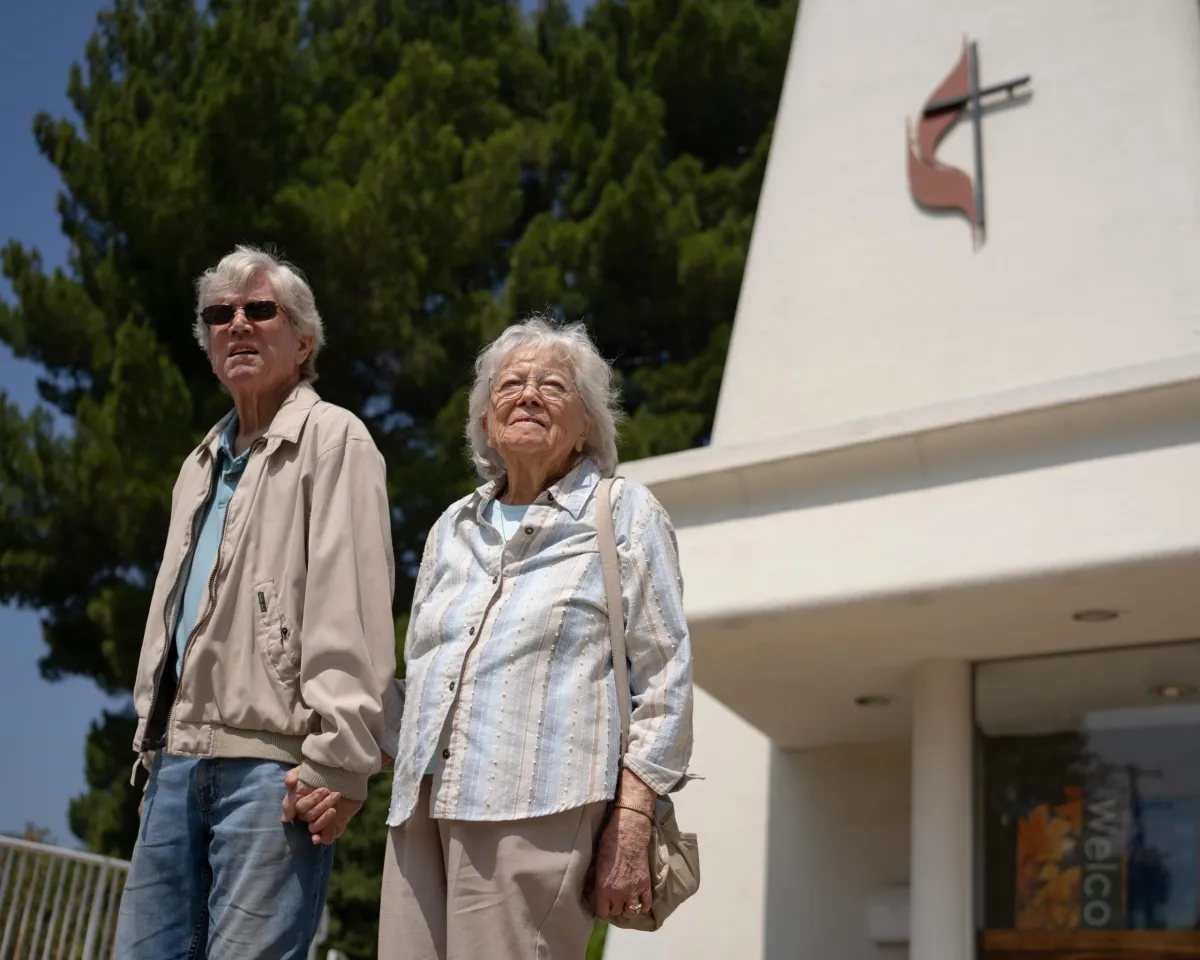
Jean and Wayne Van Vlear hold hands outside Tujunga United Methodist Church following a Sunday morning service.
Van Vlear said that some church members may have left the congregation due to Kang’s abrupt decision to house Iranian refugees, though Kang denied he’d lost any congregants because of his decision. Still, at the January trustees meeting, he could see some in attendance were upset and confused.
Then the sisters shared their stories.
The elder sister, Zohreh — who has gone by Venus since arriving in the United States — spoke to Capital & Main on the condition that her full name not be used for fear of retaliation against her family in Iran. She remembered standing in front of the strangers, most of whom were more than half a century older than her. Despite her limited English, she was eager to share her story and took the next 15 minutes to explain how and why she had travelled thousands of miles from her hometown of Shiraz, Iran, to this small church nestled in a quiet enclave at the foothills of L.A. County’s San Gabriel Mountains.
She spoke about converting from Islam to Christianity, about how the secretive homechurch she and her sister had been attending was discovered by Iranian officials, about fleeing the country in a months-long odyssey across 10 countries. She told them about trudging through the dense jungle of Panama and Colombia’s Darién Gap and wading through chest-high water while her sister battled a chronic infection that made her so weak, she often needed help to stand. She spoke about crossing the border to join their brother, who had been living in the United States since 2022, and about applying for asylum, a process that required multiple hours-long interviews with immigration officials. She talked about settling into their new lives in Los Angeles, where she enrolled at Santa Monica College to study nu
Part of an ongoing event
Iran Crisis