What's driving the rising unrest in Pakistan-administered Kashmir?
What's driving the rising unrest in Pakistan-administered Kashmir?
MEE correspondent
Frustration over basic affordability has mushroomed into a broader critique of the region's governance
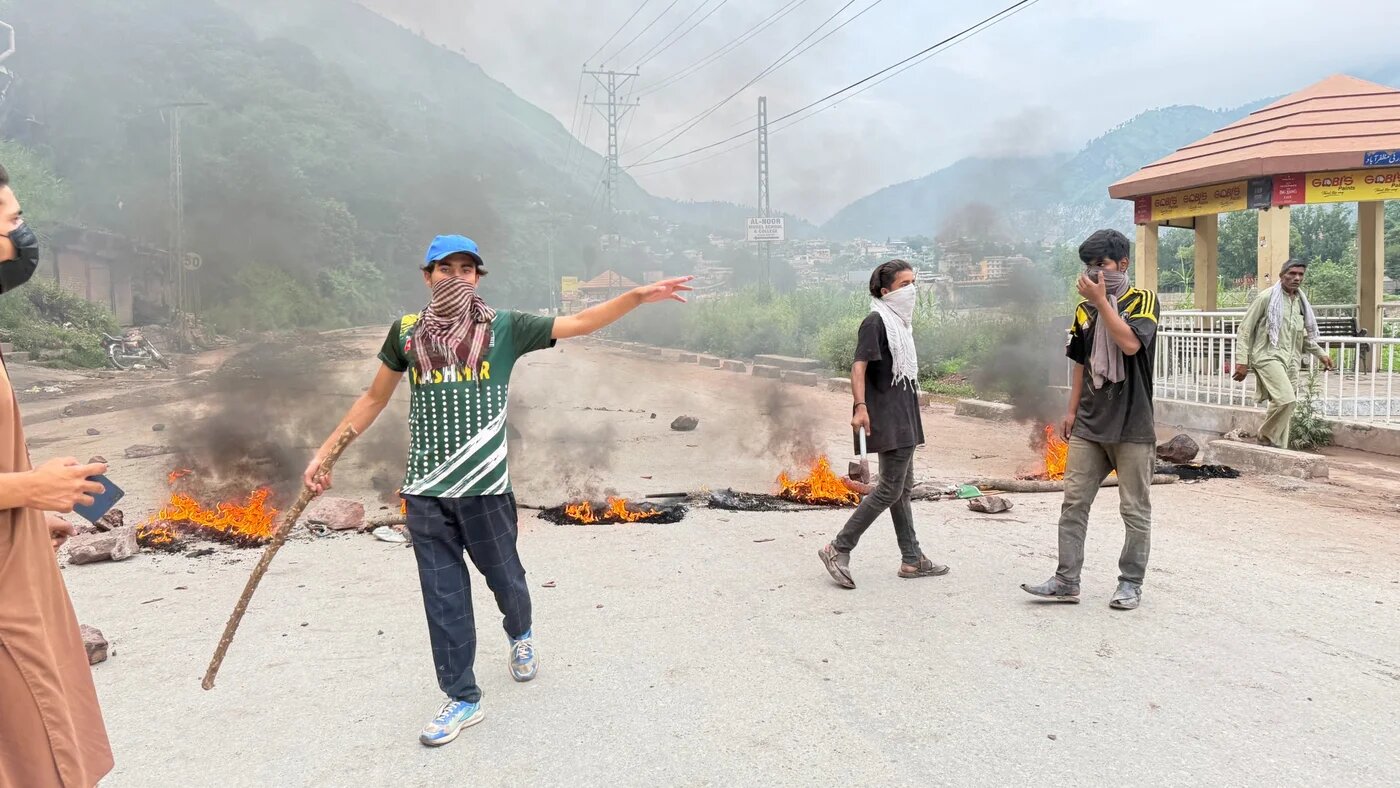
Protesters burn tyres along a road after clashes with police in Muzaffarabad amid unrest during the first phase of voting for the local legislature in Pakistan-administered Kashmir, on 31 July 2026 (Sajjad Qayyum/AFP)
For decades, global attention on Kashmir has focused overwhelmingly on the Indian-administered side of the Line of Control (LoC), the heavily militarised de facto border that divides the disputed Himalayan region between India and Pakistan.
International headlines have largely revolvedaround repression, insurgency,military deployments, and diplomatic confrontation.
Far less attention has been paid to the political currents unfolding across the LoC in Pakistan-administered Kashmir, officially known as Azad Jammu and Kashmir (AJK).
Long portrayed by Islamabad as a model of self-governance in contrast to Indian-administered Kashmir, the territory is now witnessing some of the most significant popular unrest in recent decades.
What started as frustration over soaring electricity bills and flour prices has rapidly transformed into a systemic challenge to Islamabad’s authority in the region. Rather than rehashing the old geopolitical tug-of-war with India, this new wave of unrest reflects deep-seated frustration with local governance.
Protesters are demanding genuine political participation, arguing that while Kashmir’s international fate hangs in limbo, their basic political and economic rights cannot remain frozen. In a region long treated as a geopolitical pawn, domestic disillusionment is now taking centre stage.
From economic grievances to political awakening
The protests have been led by the Joint Awami Action Committee (JAAC), a loose coalition of traders, lawyers, students, civil society activists, and local political figures that emerged in 2023 outside the traditional party structure.
Rejecting established Pakistani political parties as ineffective or overly dependent on Islamabad, the JAAC focused directly on basic issues: high electricity bills, rising flour prices, heavy taxation, and poor public services.
'What we need to know is who will provide us with jobs and a fair life today'
- Mujtaba Naqvi, JAAC supporter
This message quickly united a region facing serious economic hardship.
Youth unemployment in the area sits at roughly 27 percent, nearly triple Pakistan’s national average, while fewer than eight percent of women are in the formal workforce, Danish Khan, co-director of ‘The Inequality, Poverty, Power and Social Justice Initiative’ at Franklin & Marshall College,recently wrote in a piece for The Friday Times.
As he noted, the region was generating a growing “reserve army of young unemployed people”.
Development in the mountainous region continues to lag behind the rest of the country. Substandard roads severely restrict access to essential public services like healthcare and education, a situation that becomes especially dire during its harsh winters.
Meanwhile, many communities still bear the visible scars and lingering devastation of the 2005 earthquake that killed tens of thousands of people.
What began as a fight for affordable living soon sparked massive demonstrations across major towns, shutting down markets and forcing officials to negotiate. By 2024 and 2025, the government yielded to key demands: lowering electricity rates and subsidising wheat compared to the rest of the country.
But many activists view these concessions as temporary quick fixes.
“The p