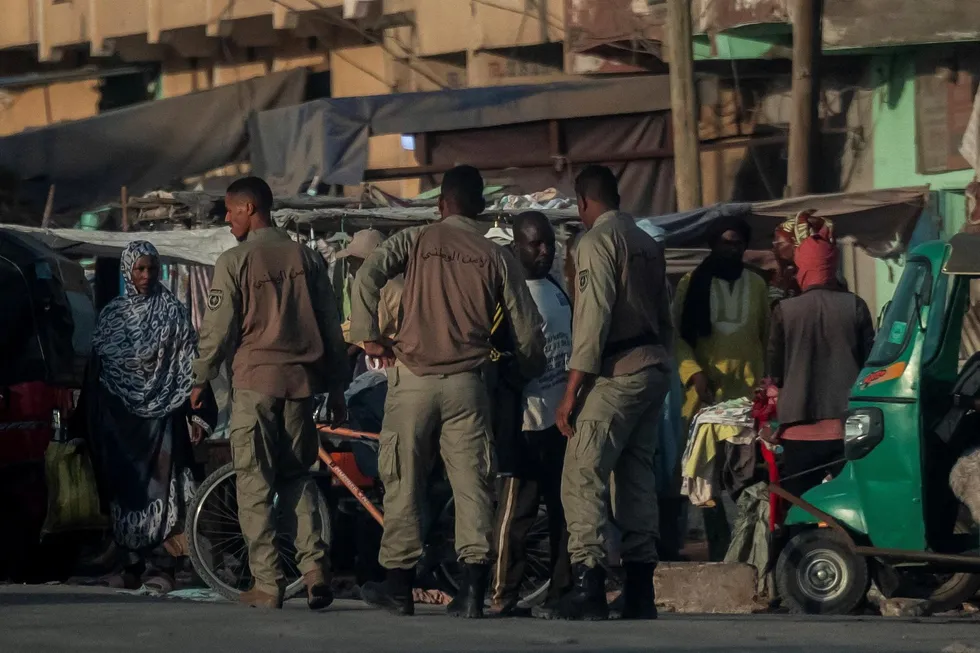
Inside The Longest Refugee Protest In History
Inside The Longest Refugee Protest In History
For over 670 days, refugees trapped in a UN camp have maintained a daily sit-in in the Sahara Desert to demand basic human rights.
Editors Note: For more than 670 days, refugees abandoned in Agadez, Niger, have pleaded for international protection, healthcare and an education for their children—and they urgently need the world’s help. x.com › refugeesniger (x.com › refugeesniger)
Matt Benson (wagingnonviolence.org › mattbenson) Waging Nonviolence
Agadez, Niger — On any given day, you will find a group of up to 1,000 people, including women, children, the elderly and people with disabilities, standing in the Sahara Desert, eight miles from the nearest town, holding signs that read “We don’t want to stay here,” “Refugees in the desert without protection” and “We don’t feel safe here.”
Since Sept. 22, 2024, they have maintained a daily sit-in at the humanitarian center where they are being held. At nearly two years, it has become one of the longest continuous refugee-led protests in history — and almost no one knows about it.
They are refugees, the majority from Sudan, others from Eritrea, Somalia, Ethiopia, Congo and Cameroon. They are among approximately 2,000 people living at the Agadez Humanitarian Center, which is managed jointly by the UN High Commissioner for Refugees, or UNHCR, and Nigerien authorities. Established in 2017 with funding from the EU, Italy and the UK, Agadez was intended as a “transit point” (refugeesinlibya.org) for refugees awaiting resettlement.
Instead, according to sources in the camp who wanted to remain anonymous for fear of retaliation, refugees are held with limited movement, no asylum processing and no resettlement path. Some have been there for more than eight years. Nigerien authorities have claimed to offer local integration, but refugees report it happens without their consent.
“We’re stuck between a homeland that can’t be returned to and a humanitarian center that can’t be lived in,” the anonymous source said. “We are held in the desert, without the most basic necessities of life. This is our suffering.”
The protesters have made their requests clear: resettlement to safe third countries, improved living conditions until then and an end to their “de facto detention.”
But they are not suffering in silence. They are still standing proudly, despite intimidation, aggression and violence from the Nigerien police and military forces, and indifference and complicity from the agency meant to protect them.
Desert conditions (youtu.be › EPQZVmCjZ7o) in Agadez are an active threat to survival. Temperatures regularly exceed 105 degrees Fahrenheit, making exposure, dehydration and heat stroke constant risks. Ironically, when the former head of UNHCR in Niger, Emmanuel Gignac, visited the camp, he complained on camera of the heat (youtube.com › twtaxCrQ35g) to refugees and insisted they only talk in the shade. Compounding the heat risks is a lack of medical care, refugees said. And for nearly a year, most have received no food rations (allafrica.com).
Children in the Agadez refugee camp join their parents on the 571th day of protest. (Amir Abdulkrem / @RefugeesNiger)
UNHCR has repeatedly stated (thenewhumanitarian.org) the center is “not a detention facility” and residents enjoy freedom of movement, a claim refugees refute. They point to mandatory passes for non-local travel, which are difficult to obtain from the local government, and often refused. Even with them, refugees face obstructions and payment of bribes at checkpoints, said a source.
A Cameroonian woman, Armelle, told Inf
Part of an ongoing event
Sahel Instability